
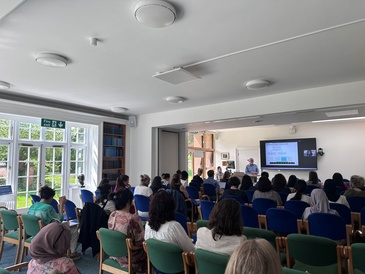
Cambridge, UK – May 2025
In response to the escalating repression of women and girls under Taliban rule, the Afghanistan Desk at the Centre for the Study of Global Human Movement, University of Cambridge, in collaboration with the International Bar Association’s Human Rights Institute (IBAHRI) and Advocates for International Development’s Rule of Law Expertise (ROLE) UK project, delivered a three-part training series titled ‘From Evidence Collection to Justice.’
Taking place in April and May 2025, the series aimed to strengthen the capacity of Afghan women in exile and their allies to document human rights violations and engage with international accountability mechanisms. Specific sessions were designed to securely incorporate women within Afghanistan and to facilitate protected, meaningful dialogue. The training was developed and delivered with significant support from Dr. Tugba Basaran, Director of The Centre for the Study of Global Human Movement.
Strengthening Legal Literacy and Advocacy through a Three-Part Series
The training unfolded across three sessions, each designed to build legal knowledge, practical documentation skills, and understanding of international legal mechanisms.
The first session, on 14 April at the UK Parliament, introduced the legal foundations of international justice. A senior expert from the Office of the Prosecutor at the International Criminal Court (ICC) presented documentation standards aligned with the ICC and EU Agency for Criminal Justice Cooperation. These standards provide a framework for how evidence is to be collected to ensure that it can support global accountability efforts.
The second session, delivered online on 28 April, was designed to enable safe participation from women in Afghanistan and to create an open channel for engagement with international experts. Alex Crawford from Sky News opened with a session on ethical journalism and the risks and responsibilities of reporting under authoritarian regimes. Nadeshda Jayakody then introduced participants to the Eyewitness to Atrocities app, a secure tool for digital evidence collection. Dr Ewelina Ochab provided practical instruction on documenting Conflict-Related Sexual Violence (CRSV), using the Murad Code and the International Protocol, with an emphasis on survivor-centred approaches.
The final session, on 1 May at the Lauterpacht Centre for International Law in Cambridge, focused on linking documentation efforts to international legal avenues. Alex Crawford reflected on strategies for sustaining global visibility for Afghan women. Richard Bennett, UN Special Rapporteur on Afghanistan, discussed entry points for stakeholder engagement with UN processes. A representative of the ICC explained options for engagement with the ICC, including the procedures for submitting evidence under Article 15 of the Rome Statute and outlined ongoing investigations into Afghanistan.
Article 15 of the Rome Statute matters in the fight against gender apartheid because it empowers the ICC Prosecutor to independently investigate and pursue accountability for systemic gender-based oppression, even when repressive regimes refuse to cooperate, or powerful states block action. It therefore offers a critical legal pathway to justice for victims. Professor Rangita de Silva de Alwis, member of the CEDAW Committee, closed the final session with an analysis of Afghanistan’s obligations under the Convention on the Elimination of All Forms of Discrimination Against Women (CEDAW) and a preview of the 2025 review.
Legal Mechanisms: From Documentation to Action
Workshop participants engaged with core international frameworks applicable to the Afghan context. The series explored the process of submitting evidence under Article 15 of the Rome Statute and examined how acts such as sexual slavery, forced marriage, and the systematic exclusion of women from public life may constitute crimes against humanity under Article 7.
Participants also examined gender apartheid, a concept increasingly used to describe the Taliban’s institutionalised, gender-based repression. Gender apartheid is not currently recognised as an international crime. However, Afghan women and international experts have been calling for its recognition and use to address the situation of women in Afghanistan.
Participants further considered the situation of women and girls in Afghanistan as a violation of Afghanistan’s international legal obligations. Among others, although Afghanistan has experienced regime change, it remains a state party to CEDAW, ratified in 2003 without reservations. Bans on education, employment, and public participation represent clear violations of Article 3 of CEDAW, which mandates the removal of any laws or customs that discriminate against women in politics and public life.
Intersectionality and Hazara Genocide Allegations
Both speakers and participants emphasised the need for intersectional documentation strategies. In addition to gender-based persecution, the Taliban’s systematic targeting of ethnic and religious minorities—particularly the Hazara community—was a central concern. Allegations of genocidal intent were raised in line with mounting evidence from international observers.
A significant development in the training was the inclusion of LGBTQ+ experiences. The forthcoming CEDAW shadow report will, for the first time, include documentation of violations against Afghan LGBTQ+ individuals, broadening the scope of legal accountability and advancing more inclusive international reporting practices.
Media Visibility and Strategic Storytelling
The Taliban has effectively outlawed independent journalism in Afghanistan by forcing over half of media outlets to close, banning women from newsrooms, and brutally suppressing critical reporting—leaving only state-approved propaganda. Several Afghan journalists in exile attended the workshops, including Zahra Joya, Founder of Rukshana Media, and a Bye-Fellow at Hughes Hall, Cambridge.
Alex Crawford underscored the severe decline in international media coverage of Afghanistan since 2021 and encouraged Afghan women to engage proactively with UK and global media. She recommended aligning advocacy efforts with global events—such as International Women’s Day—to maximise visibility. Zahra Joya reinforced the urgency of Afghan-led storytelling to maintain pressure on international actors.
“The reason you’re not getting heard in Britain,” Crawford noted, “is because people don’t know you’re there”. The audience's responses varied widely, ranging from enthusiasm about sharing their stories to scepticism toward speaking with major media outlets. Some participants expressed doubts about whether outlets like Sky News, the BBC, or other UK and European news agencies could be trusted to cover the issue accurately. For many, past experiences of misrepresentation and stereotyping had fuelled deep distrust. These concerns sparked a lively discussion about traditional media’s role in an era of online misinformation—weighing its strengths against its limitations.
Expanding a Holistic Ecosystem of Support
This training is part of a broader portfolio of initiatives developed by The Afghanistan Desk at The Centre for the Study of Global Human Movement to support Afghan women through education, legal empowerment, and community-building. These include the Mentoring Circles Initiative led by Dr Jonathan Birtwell, the English for Academic Purposes (EAP) programme, specialist working groups in law and medicine, and psycho-social support and training for remote work. The wider programme currently reaches 100 women across Afghanistan, Turkey, Tajikistan, and Pakistan, with ongoing training in secure evidence submission and remote engagement.
Outcomes and Next Steps
Following the series, workshop participants plan to establish a legal working group to support ongoing documentation and advocacy.
From there, they aim to develop survivor-centred guidance materials to assist international engagement, alongside additional online sessions to build capacity, and legal submissions and media op-eds for global dissemination.
There are still ongoing issues for the Afghan diaspora, both in the UK and elsewhere, as testified by many of the people in attendance. Pakistan and Iran, neither fully bound by the UN Refugee Convention (Pakistan unsigned, Iran only the 1951 version) host millions of Afghans while denying them legal protections and routinely deporting them back to Taliban rule. Meanwhile, transit hubs in non-signatory countries like Turkey, Malaysia, Thailand, and Indonesia trap Afghan asylum-seekers in legal limbo, often detaining or deporting them.
This reflects a broader global trend of rising anti-migrant hostility, leaving refugees caught between persecution at home and rejection abroad. Many workshop participants voiced concerns about increasingly strict refugee policies in the USA, UK, and much of Europe. They feared such measures could leave even more people in prolonged uncertainty—unable to move forward or return. Even for those who secure resettlement, the challenges of rebuilding lives and careers from scratch remain overwhelming. Participants who had lived through this experience described it as profoundly destabilizing, often triggering deep identity crises.
A Call to Action: Building Partnerships for Legal and Political Transformation
In the final session, Professor Rangita de Silva de Alwis asked, “what is it about a woman with a book that threatens a man with a gun?”
Her answer was that “an empowered woman is the greatest threat to a fundamentalist force”. Dr Marissa Quie, Convenor of the Afghanistan Desk, echoed the call, emphasising that “the courage of Afghan women deserves more than recognition. It demands action”.
This programme urges international legal bodies, journalists, academics, and policymakers to move beyond symbolic gestures. It calls for lasting and equitable partnerships with Afghan women as they document gender apartheid, challenge impunity, and reshape the international pursuit of justice.